August 22, 2014

The obligatory post-Gen Con Post

Well, Gen Con 2014 is a wrap, and one 14-hour car ride later I’m back in civilization unscathed except for an improving case of Con Crud. (I vow no handshakes next time, I’ll never learn…)

Give this guy whatever game he wants.

The New 

Lots of cell phones. And tweeting.

And everywhere was talk of Kickstarter or crowd-funded projects, which also led to more than one incident of disappointment when a vendor had limited stock of a game and only distributed copies to backers (which is I guess as it should be).

Lots more people.

The Good

I participated in more events than usual, and the folks I gamed with were awesome. I would happily play with any of these groups again. Gamers are, despite the stories, pretty awesome people. How nice to walk into those large rooms and see so many people passionately playing games—no odd questions or looks, just mutual love of the act of playing.

Met with connections & old friends. The nice thing is that my "connections" and "friends" are largely getting to be the same thing. Some were old RPG designer comrades, met new folks, missing meeting new folks (sorry Len!), and—most importantly—rekindled that creative fire. The passion for the hobby this convention represents is the reason I write game material, period.

Indy has improved. After some 5 years away—Gen Con 2009 was my last visit—I noticed new skywalks and other downtown improvements. And the local restaurants, especially that gamer-staple the RAM, were as welcoming as ever. According to Forbes, Gen Con 2013 brought more than $47 million to the city, so the welcoming attitude is perhaps to be expected, but it’s still nice. And the locals are cool folk.

Lots of new, cool games! Alas, some of my "targeted" games—see my last post—were sold out. Dead of Winter was sold out, and when I inquired with the good folks at Plaid Hat Games, they told me they had sold all 450 copies! Likewise, the Walking Dead version of Bang! Was completely sold out by 10:30 Saturday morning! (Damn!) But many other tempting offerings were to be seen, some of which I purchased.

That's a whole lot 'o zombies games right there.
The costumes were as great as ever. I hesitate to post some of the great photos I took without the permission of those involved, but the Gen Con crowd is a clever bunch, as and always, they didn’t disappoint.
RAM Hot wings!

Beer and the RAM! Nuff said! 

The Bad

Lots more people. This isn’t really bad, as more people makes for Con longevity, but navigating the ICC hallways and dealer hall on Saturday afternoon became a tiring exercise after a while. And a half-hour wait to get into the Fantasy Flight booth was an unwelcome surprise (and I heard of waits for the Paizo booth of over an hour, which is insane). Again, a double-edged sword—I’d rather them feed folks into the retail space gradually so you can breathe while you shop, but it was something new for me.

The Ugly

There honestly was no ugly, monster costumes aside. It was a great con.

The Swag/Goods

My favorite, easiest free score—available to anyone—was a free Legendary card from Upper Deck. The card was a “Wound” card, and you got to pose, be photographed, and have your picture printed on a card. Most people got solo shots, sometimes holding their head or neck, and the Photoshop artist would add a blood smear in (a Wound card, remember?). Luckily for me, an eerily good Wolverine cosplayer was in line right in front of me. He did a shot with a friend, and, with his permission, the artist merged his image with mine to have me getting the old SNIKT!

Purchases included the following:


Random d20s
Coup game (Indie Boards and Cards)
Level 7 Escape game (Privateer Press)
Level 7 Invasion game (Privateer Press)


My First Carcassonne aka The Kids of Carcassonne (Z-Man Games)
Shadows of Brimstone: Swamp of Death (Flying Frog productions)


Ticket to Ride Europe (Days of Wonder)
The Strangecorebook (Monte Cook Games)
And, of course, Dungeons & Dragons (5e) Players Handbook (Wizards of the Coast)

A good haul, I’d say. Ticket to Ride and Carcassonne were presents for my young son.

Yet another great Gen Con. Big thanks to my driving buddy and great conversation partner, Ken. Can't wait for the next one!

August 09, 2014

Stuff I'm Looking Forward to Getting at Gen Con 2014

The time is almost here! After not attending for a number of years, I'm very much looking forward to Gen Con 2014!

Here are a few items I look forward to checking out (i.e., buying) while I'm there:

1. D&D (5th Edition) Players Handbook (Wizards of the Coast)


Rather a no-brainer I would think. Although my feelings on early view of the new D&D have been mixed, no self-respecting geek could pass this by. (And yeah, I know it's available for sales in stores as I write this, but it's really a Gen Con release and I'll treat it that way!)

2. Sheriff of Nottingham (Arcane Wonders)


Let's see: The art looks gorgeous, and the game involves bluffing and lying aplenty. So what's not to like? This first game in the Dice Tower essentials line has gotten a good amount of early buzz, and I'm very intrigued.

3. Dead of Winter: A Crossroads Game (Plaid Hat Games)


While perhaps yet another zombie board game at first blush, this game has some intriguing possibilities. The "crossroads" mechanic provides an evolving character mechanic, and the game is cooperative, yet each player has a secret victory condition (some of which may not help the overall group one bit). The theme also, although undead are present, seems more post-apocalyptic and survival-oriented in nature.

I'm sure I'll have more additions to this list, but there are three early starters.

June 28, 2014

Game Review: Lord for a Day

I tried the board game Lords of Waterdeep for the first time recently.

In this board game, produced by Wizards of the Coast, players assume the role of a lord of Waterdeep—“Waterdeep” in this case being the key city in Ed Greenwood’s Forgotten Realms setting, as most D&D players would know.

I’m not going to provide a full synopsis of game play here, merely my impressions of the game and how play went. (You can find more detailed info on the game here.)

Style and Theme: The theme here was good. The art and maplike board affect a good fantasy feel, and any fan of the Realms will betreated to many familiar characters and place names. Our group had at least one player completely unfamiliar with the Realms, and the theme didn’t put him off any.

It is important to note that, at heart, this is really a more “economic” or “resource allocation” style game, and gameplay here has a very Eurogame feel.
Cubes—your main resource—are color coded to represent fighters, clerics, wizards, and thieves (D&D’s four food groups) that you, a hidden lord of the city, can dispatch on quests. Although the cubes represent adventurers, they’re still basically just colored cubes similar to those in many other eurogames, so the theme there was a tad like for me. White cubes for wizards and black cubes for thieves seemed apropos, but orange for fighters? (Maybe red would have been better?) After while, I didn’t play thinking “I need two more wizards to complete that quest” but rather “I need two more purple cubes.”

A sample quest might require, say, two gold pieces, three purple cubes (or, ahem, wizards), and two black cubes (thieves) to complete. Completing a quest earns you victory points, key to wining the game, and sometimes earn you other fringe benefits as well. One relatively minor quest I completed early on granted me a bonus Intrigue card every time I received purple cubes, which was often, and I soon found myself rolling in Intrigue cards! The aforementioned Intrigue cards spice up play, granting bonuses or hampering other players, so even though this is primarily a eurogame in feel there is some “take that!” element present. The game is not combative in feel, however, like the various RISK offshoots and such, which makes it very approachable to mixed group play.

Components: The components were top notch. The art was nice, the components and board were well produced, and the box tray was carefully designed to hold all components and cards. The card wells even have those wedges beneath, so a tap of a finger pivots a deck upwards for easy grasping—well done, WotC!

Lords of Waterdeep

Overall play: Overall play was fun, and made me want to play again soon. We played with five players, the maximum number, and everyone seemed to enjoy the game and everyone agreed they would happily play again. We had a mix of players with different game preferences at the table, so this is not insignificant. Moreover, it was a close race to the finish. We had a clear leader when points were tallied, but different players led in victory points at different times and it had the feel of a balanced, close game. The game’s first (only?) expansion Lords of Waterdeep: Scoundrels of Skullport is also now being sold, and what I’ve read about it sounds extremely promising. So some longevity of play is there.

I’d recommend this game to anyone who likes lighter resource management games, such as Puerto Rico or Settlers of Catan, or lighter fantasy games. And any Forgotten Realms fan will appreciate the theme and names dropping therein, to be sure. Lords of Waterdeep solid thumbs up from me.

Those interesting in seeing the game in greater detail or getting an excellent overview of play should watch the video here, hosted by one of the game designers, Rodney Thompson.


Components: A
Theme: B+
Gameplay: B
Overall: B+


March 30, 2014

R.I.P. David Trampier

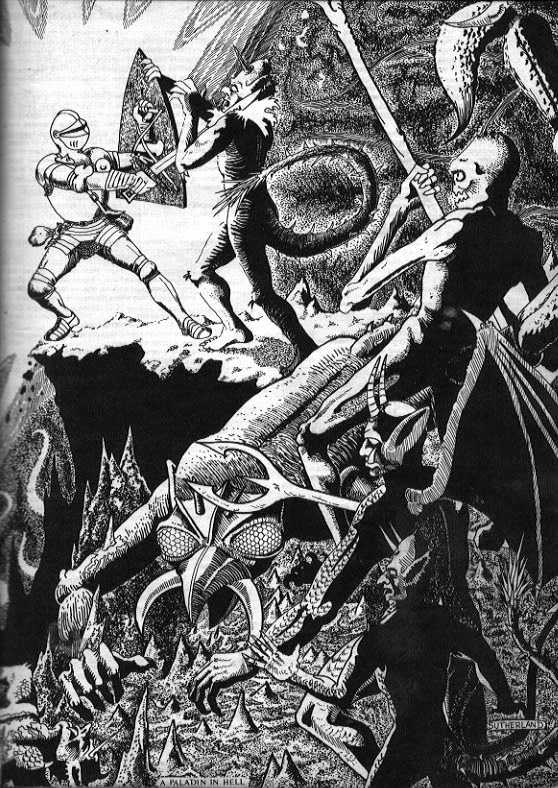
It is with profound sadness I read about the death of David Trampier aka "Tramp"—an individual that, with a few other key artists such as Dave Sutherland, Caldwell, Elmore, Easley, Fields, and Parkinson, really established the look of Dungeons and Dragons.
Certainly the duo of Trampier and Sutherland, or Dis & Dat, set down the 1st Edition style that so many have come to recognize.

Trampier’s work was always my personal favorite. His iconic work that adorns the cover of the original Player’s Handbook (below) is emblematic of D&D itself to me. Surely, his unique woodcut-like style, featuring heavy ink lines and bold characters, helped define a number of Monster Manual critters for generations of players and RPG adventure writers such as myself for years to come.


Whatever the tragic circumstances that led to his mysterious and abrupt departure from fantasy illustration (which I think is well-known and need not be repeated here), be it drugs, mental illness, or simply bad feelings toward the industry, the loss of this artist will now be felt two-fold. Greater still is the tragedy, given that he was rumored to be returning to art in recent years. Wherever you are, Mr. Trampier, you enriched and inspired this gamer with your work and I’m forever thankful.


February 03, 2014

The Lost Lair of Drecallis

Well, well, it's out! The Lost Lair of Drecallis is an OSRIC adventure for levels 4 through 7, published by Expeditious Retreat Press (XRP). I'm very happy to have completed my first project for XRP, and I hope it's but the first of many.


Troglodytes? Check. Caves? Check. 1e vibe? Oh yeah.

So if you're looking to re-live a bit of that old school magic, check it out & let me know what you think. (Not familiar with OSRIC? You can read about it here.) You can pick up an electronic copy here at RPGNow, or read about it at Joseph Browning's blog. Here's to 1e style action!

December 08, 2013

Examing RPG Player Types

Has it been that long since my last post? Yikes. Sorry, gentle reader; occasionally life gets in the way of blogging. Now back to our semi-regularly scheduled program...

I've been considering player breakdowns I've seen. There is, of course, the classic Bartle breakdown, which separates players into the camps of Killer, Socializer, Achiever, and Explorer.

Wizards of the Coast did their own player surveys in 1999 and they broke players down into the categories of Thinkers, Power Gamers, Character Actors, and Storytellers (see more information here).

I've created my own, albeit flawed, chart:


I breakdown player types as follows:

Powergamers: For these players, it's mainly about "winning" the game. Min-maxing, or exploiting the rules legally for maximum gain, is seen as the challenge. Character "builds" and optimization are the main pursuit here, a sub-game to itself, and the demonstration of the resulting build's success in play provides enjoyment. These players may feel constrained by roleplay-heavy scenarios or games wherein the GM limits access to magic items and additional player/character options.

Tacticians: For these players, the rules are viewed in a tactical sense, much as in a wargame or certain boardgames. Enjoyment typically comes from combat and tabletop figure actions, movement, and defeating the opposition via strategy and shrewd moves. These folks can get restless if combats are spread out too far apart, and they often enjoy sub-games within the overall game, such as bargaining sessions or gambling games. Skill challenges via dice are preferred to the roleplay only style.

Thinkers: For this player type, the game is often about figuring out puzzles or mysteries, and campaigns or adventures that contain an element or plot to be deciphered is key to the enjoyment. Battles are enjoyed, but ultimate enjoyment comes from the steady unravelling of the plot, providing of clues, a d the success of one's hunches. Character builds are viewed as less important to this player, as they trust their own (real life) brain power more.

Storytellers: For this player type, the overall game goal and enjoyment stems from advancing the overall narrative, and in line with that establishing memorable scenes, NPCs, and an "epic" story. These players enjoy longer campaigns more that one-offs, and long advancement of levels and character growth is valued for the narrative more than the acquisition of power(s). Short, less meaningful battles that do not advance the story may be accepted but are not valued as much as key set pieces.

There are some subsets to the above. The Storyteller quarter could actually be broken, subdivided, into halves—one half of which might contain an Actor subtype that focuses exclusively on the roleplay aspect, enjoying the game for the person-to-person (or PC-to-PC) conversation, the "be another person" escapism, etc.

Unlike many charts of this type, you'll notice the dividing line between the blue and yellow boxes. This chart is more an arc than a square, truth be told, with the player type ranging from the pure "role"-player to the "roll"-player.

I must think more on this, but here are my early impressions on a cold winter day.

September 22, 2013

M.A.Y.B.E a good time? Nah, definitely.

I spend much of the day and evening today with an old friend at the Maybe Games event: MAYBE (Metro-Area Yearly Boardgame Event). It was a lot of folks sitting around playing boardgames, and it was a great place for me to both try out new games and meet new folks.

As it turns out, every game I played was my first time with that game, so I certainly got exposed to a number of games I had been curious about. Here's the line-up, and some quick thoughts about each:

1. Race for the Galaxy (Rio Grande)

Pros: Lots of options, and lots of expansions. No two games will be alike. And it's a fast game—truly a race, as my friend Dave said. The cards were nice illustrated and evokative,

Cons: All those symbols! They make sense, but my eyes were still bleeding after the first game. Even without the expansions, this is a game that's probably going to take several run-throughs to get down, and I don't see into being very approachable to the more casual gamer.

2. Battlestar Galactica (Fantasy Flight)

Pros: An enjoyable, “who’s the traitor?” style game. Resource management and teamwork are both key here, and it’s more thematic and involving than, say, Pandemic. Slowly realizing the identity of the traitor (or traitors!) is a blast.

Cons: I found myself wishing there was more to do, or more room options. I sometimes found myself making repeat visits to areas and wishing I had something else to do. Combat my starfighters outside the ship also felt like more of an afterthought to me—fun, but hardly engaging or tense.

3. Dominion (Rio Grande)

Pros: Finally I see what the fuss is about. Play was fast and fun, and lent itself to tat “just one more game” vibe. The overall rules area easy to grasp, but you can take different paths or strategies to victory. I found myself thinking about card combos, much in the way I would if I were playing MAGIC: The Gathering. And of course, lots of game expansions await the newfound fan.

Cons: Play was somewhat clinical, and very theme light.


I played other games as well, and I’ll try to add my thoughts of them as well when time allows…
Related Posts Plugin for WordPress, Blogger...