August 17, 2007

And now the news...

It would appear that Dungeons & Dragons 4.0 has arrived (or at least been announced), and the hordes at Gen Con are getting some small details as to the direction the game is going. My reaction to the news? Many questions. How will this effect the Open Game License / SRD? (I heard that the OGL will thankfully continue, but details are scarce.) How good will the online utilities actually be? Will the game become even more miniatures oriented? It’s a frightening time, especially for d20 authors, but also a very exciting time, to be sure.

The coming days will hold many answers, and I can’t wait.


I’d be remiss if I didn’t mention here my meeting with Mike Ferguson this past weekend. (Check out Mike’s blog here! And if you haven’t checked out Mike’s Goodman Games modules and other products [such as the Known Realms boxed set, which he co-wrote with Jeff LaSala and Harley Stroh], I heartily suggest you do.) Mike is a fantastic guy, and he has an infectious enthusiasm for gaming and writing that shows; before I knew it we had spent a few fast hours sitting over pizza, chatting away about the RPG business. Assuming this 4e news doesn’t rain on our parade, I can think of nothing better than a future combined project—it would be interesting indeed to see what our “fevered minds” can create together. Some of our talk involved just such a prospective project, and I hope all comes to pass.

To the future!

June 06, 2007

Start the Fantastic with the Real

Part of the fun of RPG adventure writing, for me at least, is the act of creating something from nothing. Spinning a saga whole-cloth from the old Grey Room is a fine art, and when the process works and you can sit back and examine what you’ve created and … well, it’s great. Sort of like enjoying a gourmet meal you spent all day cooking, to use an easy culinary analogy.

Trouble is, our brains often follow a similar track. Not mine to yours, but mine to mine. If I create one dungeon, I’ve got to be careful to make the next one different, and so on. It’s easy to get into a mental rut. If I design a underwater sahuagin palace with the same standard outer guard rooms as my last orc cave complex, what’s the point? They might as well all be orc complexes.

Some RPG authors are good at keeping things fresh. Gary Gygax wrote three giant lair modules and each one presented a unique giant lair. That's adventure writing. But for most of us, it's more of a challenge to keep things fresh.

I’ve finally come to realize that using the real world for inspiration isn’t a bad thing. Our real world is loaded with inspiration. So is our media. Seen a good movie lately? Have a favorite old Star Trek episode? Remember a creepy gothic story? (Go H. P. Lovecraft! Ph'nglui mglw'nafh Cthulhu R'lyeh wgah'nagl fhtagn!) Hear about some political machinations on public radio? Read about a devious murderer finally brought to justice? It’s all good fodder for the mill. Sometimes the mere act of watching a fantasy movie—even a cheesy one—is enough to jump-start my mental engine. Take ideas when they appear and run far with them.

Real world cultures are also a fantastic inspiration. The other day I watched a dog show on television and I was boggled as to the sheer number of breeds of every size and shape out there (and yes, I know man custom breed many of them, don’t spoil my fun). In a similar fashion, the range of cultures that have inhabited our planet blows my mind. Eskimos, Viking warriors, samurai, Hopi Indian, Aztec, … it goes on and on. All these cultures have art, homesteads, rituals, clothing, religion, ways of war, methods of surviving, etc., all unique to them. Compare ancient Japanese armor to Middle Age European armor—very different, yet both fairly effective for their time. All armor doesn't have to be the same. And all dungeons need not be the same either.


Currently I’m working on a potential project and I’m using the Anasazi, Mayan, Aztec, and American Indian (Sioux and Chippewa /Ojibwa tribes, and others) as inspiration in developing several humanoid cultures and customs. Does this mean my humanoids believe in Thunderbirds or Huitzilopochtli? Not quite. But perhaps my humanoid tribe leaves petraglyphs on rock walls. Perhaps they sacrifice prisoners to their god. Maybe they even play a primitive ball game, not unlike pitz.

When I envision weird temples or ruins, I might think of Tulum or Stonehenge, or when I create a castle, I might think of Cardiff Castle; to name three real-life places that I was able to visit in person that later had a direct effect on my writing. My current ruin-muse is Angkor Wat (haven't gotten there yet, unfortunately).


The idea is to draw upon the basic ideas, the things that make you interested, and make them your own. Soon all your dungeons won't look the same anymore, and your readers and players will thank you for it.

May 17, 2007

Fringe Benefits

The other day a got a reminder of one of the fringe benefits that comes with creating published work, especially adventure writing.

There's no denying that part of the joy of being a writer is knowing others actually read your work (or, dare we say it, enjoy it too). That's where it's at. Getting your name on the cover is cool, and getting the check in the mail ain't bad either, but an unread book or adventure is a play performed before an empty house. Unread work lies, to an author's pain, in the drifty realm of the lost, the abandoned, and the nugatory. The work simply isn't complete until that magical bond between writer and reader is forged. In the case of adventure writing, there exists a further level, because getting them to actually play it becomes the highest pinnacle.

Years ago (many years ago actually, it's scary how they go by) I had a good-length adventure published in Dungeon magazine. Chris Perkins, bless his soul, had recently taken over as editor and took the first thing I sent him. There were bumps in the road—oh yes—my query got misplaced in their offices, I was return-mailed some else's manuscript at one point, and when it was revision time they informed me that their policy had changed and they were now, mid-stream, lowering the maximum length of all adventures, including mine. I had to cut nearly 6,000 words, pages of good material that survived the editor's red pen untouched, from the manuscript. Still, they took it and printed it and I was a very happy camper.

A year or two later (still back in the Milwaukee days) I attended Gen Con with a friend, and I found myself squatting before a vendor's bookshelf loaded with old TSR mags. Next to me a fellow gamer was flipping through the Dungeons and his hand lingered on mine for a moment. I longed to open my mouth and cry "Take that one! Inside is the best damn adventure ever!" but in the end I smiled and turned back to my own shopping (to the best of my knowledge, he bought a different issue).


Two weeks ago I was standing in a hobby store, thumbing through the latest WotC hardcover (they seem to come out on a weekly basis these days) and two gents walked by me, chatting about the Dungeon Crawl Classics line. My ears perked up, and I continued to scan the text before me whilst opening my sound holes a bit wider to catch the drift of what they were saying. They drifted over to a metal rack about 10 feet away, one of those spinning numbers, loaded with DCC adventure modules.

"Yeah, some of them are pretty good," the first guy said. I couldn't hear the reply, but it seemed to be in agreement. He pointed to a module on the far side, out of my viewing range.

"This one was pretty decent," he said, gesturing with an index finger. His eyes moved rapidly over the books, discarding a module and quickly moving to the next. He pointed to another. "And this one was really good..."

I waited as the rack spun and the module I authored came into view.

"And this one was a good one," he said, with a last decisive jab of his forefinger. He was pointing at mine.

And l happily bit my tongue.

April 19, 2007

The End of an Era

It is with incredible sadness that I make this post. The startling announcement that Wizards of the Coast deicided to terminate Paizo’s license to produce Dragon and Dungeon magazines took me and a host of others by surprise. It seems WotC feels the in-print magazines will compete with their coming online venture.

I grew up with both magazines. I picked up Dragon #42 (pictured, center above) on a whim at a California gaming store and was soon hooked. My start with Dungeon began with #5. I guess that makes me a pretty old gaming geek!

I love the magazines. They've had their ups (the "old" Dragon!) & downs (the mid-90s Dragon) but the magazine provided the best, hands down, regular source of gaming material, particularly in the pre-Internet age. I'm highly computerized and no Luddite—I once worked in hardware repair for years and now check my e-mail habitually—but nothing beats having a real, printed, paper magazine sitting in my hands. I've got boxes full of the old ones and even after getting my hands on the ultra-hard-to-get (at least for less than a prince's ransom) Dragon 250-issue CD Set I still prefer digging into my old cardboard boxes and getting out the real thing.


My first published adventure appeared in Dungeon #67. It was a great experience and taught me a hell of a lot about the RPG business, so the mag is dear to my heart. Dragon too found a home for my letters, including a running debate about the "TSR rules thugs"—I term I coined in those ancient pages that still gets laughs of recognition from the old-timers in online forums. The mags and their editors were kind to me.


Dragon and Dungeon were gaming institutions, and rightly so. The art and articles and cartoons that graced those mags over the years is drool-worthy and earned my respect (and money) long ago.

The most recent publisher (position-wise) of the magazines, Erik Mona, turned around the semi-failing Dungeon and stagnant Dragon and brought vibrancy back to both. Dungeon in particular has really shined this last few years. I wish the Paizo boys the very best with Pathfinder and their other projects, and I hope we truly haven't seen the last of these two great, venerable titles.

April 06, 2007

Easter Eggs

I love Easter eggs ... the RPG adventure type, that is.

So-called "easter eggs" are the little hidden rooms or interesting areas tucked away in an adventure or dungeon, something that the player characters might discover if they are lucky, clever, or very unfortunate indeed. (I also like the humorous so-called easter eggs tucked away in modules—I've found many in old TSR modules—but that's a topic all its own & one I'll get to another day...) Goodman Games encourages their writers to add eggs into adventures, and some adventures have had some good ones. The GG adventure The Secret of the Smuggler' Cove had what might be the most fiendish I've seen—a cave shrine that may only be reached via a underwater swim. (As a certified SCUBA diver, I can tell you that cave-diving is more dangerous than most non-diver gamers would dream, which just adds to the appeal!)

The best adventure bits for me are the weird ones and the creepy ones. They don't have to be cleverly hidden or impossible to reach, just really interesting and "out of place" in the context of the overall dungeon with being totally jarring. This is not to say I dislike cohesive dungeons—I don't, and good adventure design fairly demands it—but those weird, mysterious touches get me every time. Gary Gygax was a master at this, and finding the little disturbing rooms he salted in his large dungeons was like biting into a big piece of jalapeno in the nacho heap—you knew it when you hit one.

A great example is his venerable Steading of the Hill Giant Chief. The module contains a two-room area on the lower level, just off to the side of the feuding humanoids, that contains a weird little temple and a "vestry" that basically amounts to a blocked passage.
The temple is tiny and bears little connection to the overall place, except to imply that once, long ago, the hill giants (or unknown others) worshipped things better left alone. The place had the standard Gygax descriptions that evoked multiple senses (there were "greasy feeling" columns there!) and it was short & sweet, yet creepy. The fact that a PC could go insane in the room didn't hurt. It was still the days of the 1st Edition, and characters acting greedy in weird temples usually came to bad ends, and quickly...

When I wrote my own The Scaly God (plugga plugga) I made a point of creating my own little weird temple as my easter egg. It's hard to find/reach, and it hopefully plays a bit of easter egg homage to E. Gary Gygax (note the initals—EGG) at the same time. When writing it, I tried to keep my own unique voice in the design as I always do, but all those weird temples over the years, from the awesome Giant series to the Forgotten Temple of Tharizdun, still burned in my brain and it showed. That's a good thing.

In real life, I detest eggs. But in when it comes to adventures, definitely serve me up a couple of easter eggs, weird side up.

January 05, 2007

Dinos and Rust Monsters

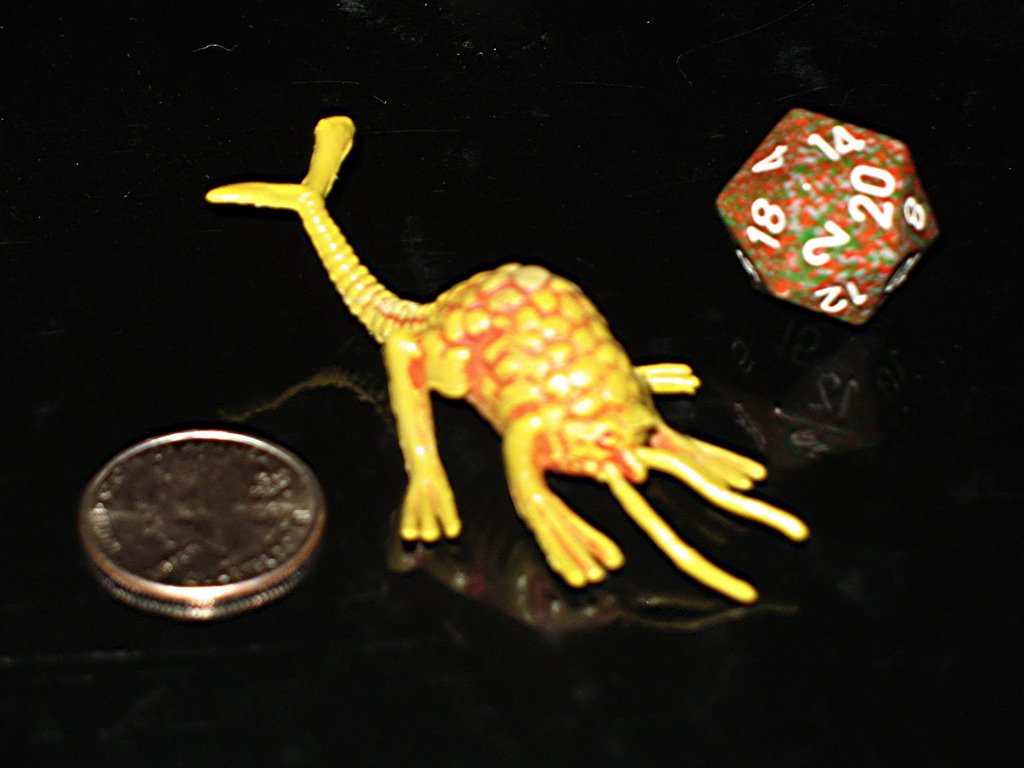
It was long rumored that Gary Gygax once purchased a plastic bag of those little plastic dinosaurs (of the type you purchase in hobby and toy stores) and discovered a few odd critters in the bag. He promptly made them into D&D game creatures. The monsters created included the bulette and rust monster, and possibly others. This rumor has since been confirmed by the Master himself.

Many years ago I stopped into a KB-Toys on a whim, and there, sittting in a glass container on the counter loaded with rubber spiders and such was a tiny rust monster. I promptly grabbed it, paid for it (it was less than one dollar), and "Lucky the Rust Monster" has been tied to one string of my venerable dice bag ever since. That was sometime in the early 1980s.

I've since seen at least one other picture of a similar plastic critter—identical really, except for a bit more brown color—and confirmed as best possible that I have the same plastic monster EGG grabbed years before. So, without further ado, I present Lucky the Rust Monster...


(Thanks for the EN World folks for inspiring this post!)

December 18, 2006

Run Away!

Is the act of running away a lost art?

A complaint I’ve heard more than once regarding player behavior in the age of Third Edition is “videogame style play”—more specifically, a style of behavior in which players have their characters fight, rest up, fight, rest up, ad nauseam, plodding straight ahead with little thought of serious problem-solving, alternate routes, or flight (especially the latter).
Now the videogame criticism is over-played by many RPG old-timers and often unfairly directed against many younger players in particular, but I do understand the point. The style of play described works fine in an electronic game such as Call of Duty, of which I happen be a fan, but in D&D the straightforward approach isn’t always the best or only route—and it shouldn’t be.

In this time of Third Edition ELs, CRs, and other alphabet soup game guidelines, it’s easy for players to be lulled into a false sense of security. They know a good GM follows these guidelines, so they trust that an adventure will be balanced with regard to PC levels. Taken at face value, this is fine—players have every right to expect that their characters will be neither unduly slaughtered nor so lacking for challenge that they will fall asleep. At a certain point however, this strains credibility. Why do purple worms never seem to lurk in the same cavern complexes populated by gricks or chokers? ("Well, because their challenge ratings are too far apart, you see...") Using the challenge levels properly also leads to an abundance of humanoids at the lower levels, I've seen.

I enjoy low-level play—there’s a real challenge when a few hits can really threaten your characters (and a possible critical hit on a PC becomes a truly terrifying event)—but I am soooo sick of the goblins. Getting from 1st level to 5th level without fighting goblins, hobgoblins, orcs, or kobolds is a near-impossible event. I like humanoids as much as the next guy, but the obligatory humanoid stomp on the way up the XP ladder is getting old. I’m an old 1st- and 2nd Edition player, and I’ve seen many, many characters of mine never get past 6th level, so maybe that’s part of the problem, I don’t know. As I said once to a friend of mine that is a great fan of low-level, humanoid-heavy play, “I’m getting tired of chalking up … I want to shoot pool* sometimes too.” Everybody likes a good, crowded kobold smash sometimes, and occasionally it even makes for good comic relief, but more often it’s the hydras and behirs and black dragons that make for the special battles we really remember.


The ability to level up nearly any monster or humanoid in Third Edition has added a welcome surprise factor (and added danger) to some of the more mundane encounters, but in this writer’s humble opinion there’s nothing wrong with the characters running away when needed. Adding one encounter per adventure that is a bit more than the PC party can chew isn’t a sin … it might be a welcome dose of reality.

In The Scaly God, I added an encounter that was extremely dangerous—one that any sensible party would back away from if the scene if GMed properly. I went as far as to include a warning note for the GM in the module, telling her that it would be fair play to warn the party that real trouble lies ahead.
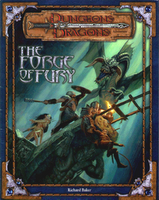
Richard Baker did something similar in his Forge of Fury adventure. In this 3rd-level adventure, there is an area in which dwells a roper. That’s right … a roper! Allowing PCs in a 3rd-level dungeon to possibly run into a CR 12 creature is perhaps madness, but Baker did it with style, including notes for the GM. Call me a heretic, but I see nothing wrong with this so long as the author and GM play fair about it.

Sometimes too much is too much, and, given some warning, the adventurers should realize that sometimes it’s best to skedaddle and live to fight another day.

*Lousy metaphor. As some of the Goodman Games folks can atest, I'm no pool shark.

Related Posts Plugin for WordPress, Blogger...